
Improving Everyday Communication With Autistic Children
A practical guide for parents, teachers, siblings, and support people: with a free tool for parents.

Most autistic children are described as “not communicating.”
What adults usually mean is: they are not communicating in the format I expected.
That difference matters. If we miss the communication that is already happening, we add pressure.
Pressure is what shuts communication down.
I’m writing this as a parent of a non-speaking autistic child.
I had to unlearn the idea that communication only counts when it sounds like words. I used to think I needed to help him “use words.”
So I talked more. Prompted more. Asked more questions. And it did not create more communication. It created more pressure.
That was the shift for me: communication was already happening. I just had to learn how to see it.
My child does not need speech to be communicating. He needs people who notice his body, his sounds, his movement, his reaching, his refusal, his joy, and his distress as real communication.
Autistic children are already communicating.
It is not that your child is unwilling.
Instead, it is an access problem.
When communication breaks down, it is usually a mismatch between:
nervous system state
environment
expectations
Not a lack of effort.
Communication is more than speech
Communication includes:
movement
gestures
repetition (echolalia)
silence
behavior changes
If behavior shifts, communication is happening.
Your job is not to make it look typical.
Your job is to understand it and reduce barriers.
Start with regulation
If the system is overloaded, language drops.
Before adding more words, reduce load:
lower noise
slow down
use fewer words
move to a quieter space
Say less. Do more.
Core strategies that actually work
Use clear, concrete language
“Shoes on” works better than “Let’s get ready.”
Wait longer
Silence is often processing, not refusal.
Use statements over questions
Reduce pressure. Model language instead of testing it.
Match, then expand
Child: “Truck”
You: “Blue truck”
Pair words with visuals or gestures
Spoken language disappears. Visuals stay.
What most adults miss
Echolalia is communication.
Avoidance is communication.
Movement is communication.
If you ignore it or correct it, communication drops.
If you respond to it, communication grows.
Build interaction without pressure
follow the child’s lead
join instead of redirecting
imitate sounds or actions
pause during routines and wait
Any response counts.
Reinforce it immediately: “You asked for more. Here you go.”
Stop requiring performance
Do not require:
eye contact
immediate answers
verbal responses
These increase pressure and reduce access.
Listening does not require eye contact.
Communication does not require speech.
Use AAC early
AAC (pictures, signs, devices) gives access to communication.
It does not prevent speech.
It often supports it.
The goal is being understood, not forcing speech.
When things fall apart
Do not ask: “What’s wrong with this behavior?”
Ask: “What is this behavior communicating?”
Then check:
Was the environment too much?
Was the language unclear?
Was the demand too high?
Was the timing off?
Fix that first.
The shift
Autistic communication is not broken. It is different.
When you reduce pressure, increase clarity, and respond to what is already there, communication improves.
Because access increased.
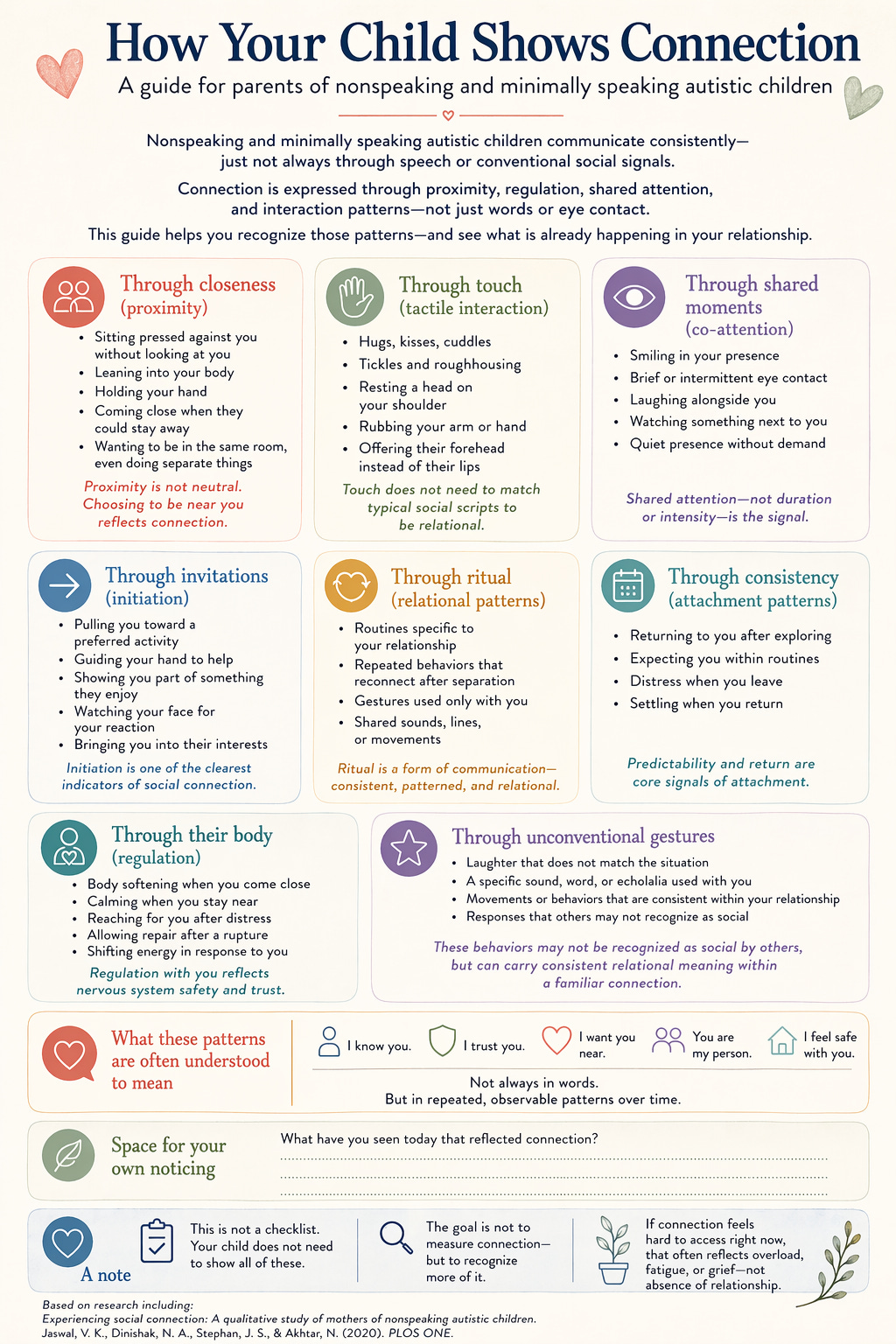
I made this for parents like me — raising nonspeaking or minimally speaking autistic children, and sometimes wondering if the connection is there.
It is. This is how to see it.
Free to download. Share it with anyone who needs it.
Based on: Jaswal, V. K., Dinishak, J., Stephan, C., & Akhtar, N. (2020). Experiencing social connection: A qualitative study of mothers of nonspeaking autistic children. PLOS ONE.
If this helped, there’s more. The full Unmasked Parenting toolkit — nervous system guides, regulation-first tools, and practical reference cards for neurodivergent families — is available for paid subscribers.
Resource base
Barry Prizant (SCERTS: regulation, communication, environmental supports)
American Speech-Language-Hearing Association (AAC supports communication and does not inhibit speech)
The Hanen Centre (follow the child’s lead, wait, model)
National Institute on Deafness and Other Communication Disorders (variation in communication profiles)